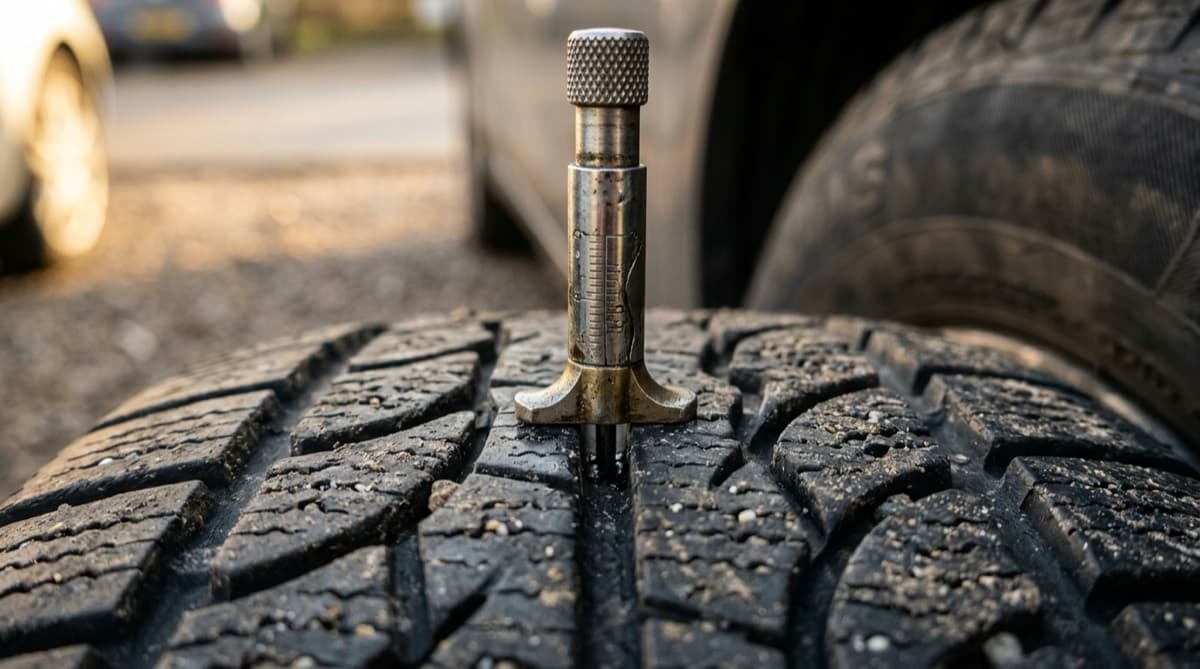
Understanding Tread Depth Measurements
Tread depth is measured in 32nds of an inch. A brand-new passenger tire typically starts at 10/32" to 11/32". Here's what each measurement means in practice:
Method 1: The Penny Test
The penny test is the quickest way to check whether a tire has enough tread to be legally safe.
- Hold a penny with Lincoln's head pointing down between your fingers.
- Insert it into the tread groove, pointing Lincoln's head into the tire.
- If you can see all of Lincoln's head, the tread is at or below 2/32" — do not buy.
- If Lincoln's head disappears into the tread, the tire has more than 2/32" remaining.
Method 2: The Quarter Test
The quarter test gives you a better threshold for safe all-weather use — the 4/32" mark.
- Hold a quarter with Washington's head pointing down.
- Insert it into the tread groove.
- If the tread reaches Washington's hairline, you have at least 4/32" — minimum recommended for wet driving.
- If the tread covers Washington's head entirely, you likely have 6/32" or more — a good used tire.
Method 3: Tread Depth Gauge (Most Accurate)
A tread depth gauge costs $5–$10 and gives you an exact reading in 32nds of an inch. Every serious used tire buyer should carry one.
- Press the probe straight down into the center groove of the tire tread.
- Push the shoulder of the gauge flush with the tire surface.
- Read the measurement on the dial or slide — most gauges show 32nds of an inch.
- Repeat at 3–4 points around the tire to check for uneven wear.
- If the readings vary by more than 2/32" across the tire width, the tire has been worn unevenly — a red flag.
Reading the Tread Wear Indicators
All modern tires have built-in tread wear indicators (TWI) — small rubber bars molded into the tread grooves at exactly 2/32". When the tread surface is flush with these bars, the tire is legally worn out.
Look for the small triangle symbol (▲) on the tire sidewall — it points to where the wear bar is located in the groove. If the wear bar is even close to flush with the surrounding tread, walk away.
Check for Uneven Wear Patterns
Beyond depth, the pattern of wear tells you a lot about a tire's history:
Center wear
Over-inflation — tire was run with too much air pressure
Edge wear (both sides)
Under-inflation — tire was run soft for extended periods
One-sided wear
Alignment issue or camber problem — the vehicle had a suspension problem
Cupping / scalloping
Worn shock absorbers — tire was bouncing instead of rolling smoothly
Feathering (sawtooth)
Toe misalignment — tread blocks are worn on one side
Any tire with one-sided wear, cupping, or feathering should be avoided — these patterns indicate the tire was not running true and will continue to wear abnormally even after mounting on a well-aligned vehicle.
Check the pressure after mounting
Used tires should be set to the PSI on your door jamb sticker, and checked again the next morning. A cordless inflator lets you do that at home. Fanttik makes several.
See Fanttik tire inflators →Contains affiliate links — how we make money.
Don't Forget the DOT Date Code
Tread depth isn't everything. A tire with 8/32" of tread but 8 years old is still a bad buy. Rubber degrades over time, developing microscopic cracks that compromise structural integrity — even if the surface looks fine.
Find the DOT code on the sidewall. The last 4 digits tell you the manufacture week and year (e.g., 2419 = 24th week of 2019). Avoid any tire older than 6 years from manufacture date, regardless of tread depth.